

On 22 October 2026 the ABC’s technology reporter James Purtill wrote that a new generation of AI tools is making it “relatively easy and fast to clone an existing piece of software and replicate its features”, and that some are calling it “the end of software” (ABC News, 22/10/2026). Our take: copying other people’s products is the least interesting thing you can do with this, and copyright itself is overdue for a rethink in a world where software is built with AI. The interesting thing is that the cost of making software has collapsed, which means a small business can now have software the way it has a shed: built for the job, owned outright, and still there in ten years. We call that forever software. Ironbark, the free music player we released this month, is our proof that it works, and our notes on what it costs.
This article quotes the ABC’s reporting with attribution. It’s general information and our opinion, not legal advice.
What the ABC reported
Three things happened in October, according to the ABC. A small team of developers used AI tools to build near-identical, free versions of Microsoft Office and Adobe Creative, Photoshop included; the ABC notes an Adobe Creative Suite licence costs more than $1,000 a year and the clone is free. A project called Reverse Engineer Anything, which helps people use AI to pull apart and replicate features of other software, shot to the top of GitHub’s trending list. And, the ABC reports, the reverse-engineering forums are full of people replacing car dashboards, keeping old games alive after their vendors dropped them, stripping ads from smart TVs, and trying to get printers to accept cheaper ink.
Brandon Thomas, one of the developers behind the Office and Adobe clones, told the ABC he sees it as a fight for the future of the internet. Of the 1990s web he said: “Everything in this era could be inspected, copied, shared with friends, remixed.” Then, he says, “Everything became a walled garden fiefdom, extractive and rent seeking.” His conclusion: “AI flips the tide of this war in a way legislation never did.”


The ABC links that to “enshittification”, writer Cory Doctorow’s 2022 word for the slow decline of online services: feeds that turned into ads, search results crowded out by sponsored links, and software that moved to subscription-only billing with cancellation fees the ABC says can reach 50 per cent of the annual contract.
The experts the ABC spoke to were more measured. Professor Marek Kowalkiewicz, a digital economy expert at Queensland University of Technology, said AI-powered reverse engineering is not so different from a room full of human developers doing the same thing, “but it’s way faster and cheaper”. “In the past, I could have hired 100 developers to create a copy. Now it’s not expensive anymore,” he said, and he expects big software companies to lobby for more protection: “It’s an arms race.”
The ABC, citing Malcolm Burrows, a lawyer at Dundas Lawyers, reports that software in Australia is protected by copyright as a literary work, and that a reverse-engineered program is unlawful where it is a “substantial reproduction” of the original. The problem is proving it when the copy was made without ever seeing the source code. “It’s going to get very grey,” he said.
And Dr Aaron Snoswell, a QUT computer scientist, worried the tools devalue developers’ work and will push companies to automate even more of it. He gave the ABC the example of independent game developers who spend years on a game only to see “someone in one weekend” produce a working copy. “What point is there in building with human effort, with human soul,” he asked, if it can be stolen like that?
Where we agree, and where we don’t
We agree with the diagnosis. We’ve written before about dark patterns and hidden fees and prices that aren’t the price. A lot of the software a small business pays for every month has got worse while it got dearer, and the only thing holding customers in place is that leaving is hard. Mr Thomas is right that the technical ground has shifted under that model.
Copyright is a concept that needs a fresh look in a world where software is increasingly built with AI tools, and the first question is an awkward one for the companies now lobbying for more of it: if a company builds its product with AI, is the result copyrighted at all? Australian courts have held that copyright needs a human author, so a program written mostly by an AI may have much less protection than its owner assumes, possibly none for the parts no human actually wrote. Nobody knows yet where that line sits, and every big software company is now shipping code its own AI tools wrote, so they’re about to find out on both sides of it.
Then there’s how long it lasts. In Australia, copyright in a work runs for 70 years after the author dies: the human programmer’s lifetime, even when a company owns the code. That term was set with books and music in mind, and even there it’s generous. For software, which is obsolete in five years and often won’t run in twenty, a term measured in generations isn’t protecting anyone’s livelihood. It’s just keeping old things locked. Things move faster than they ever have, and what copyright means, and how long it lasts, should be re-examined at the pace of today’s world rather than the 1700s.
So where’s the line? Cloning someone’s product and selling the clone as commercial software of your own is blatant, and nobody needs a lawyer to tell them so. Private, non-commercial use is a different question. If you rebuild a tool you’ve paid for so you can keep using it after the vendor switches it off, it’s hard to say who has been harmed, and whether that should be allowed is a question worth asking out loud. Compatibility is different again. More and more of our lives sit in “closed” formats: a .psd is a picture, but you may need Photoshop just to see it. Australian law already lets the legitimate owner or licensee of a program study it and, if necessary, decompile it to get the information needed to build a separate program that works with it, including one that reads its files, though only as far as is reasonably necessary, only when the information isn’t readily available elsewhere, and only for that purpose (Copyright Act 1968, s 47D). More of that, not less, seems to us the direction a sane system would take. What a program does is an idea, and ideas were never meant to be owned. The code is the work.
Where we do part company with the cloners is Dr Snoswell’s point, which we think deserves more weight than the ABC’s cheerful forum posters gave it. The indie developer who spent fourteen years on a game is exactly the kind of small business we work for. A world where anyone’s product can be copied in a weekend is not obviously a better world for small operators. It’s a better world for whoever has the biggest distribution, which usually means the companies the cloners say they’re fighting.
But notice what that objection is about: copying other people’s products. Take that out and what’s left is the thing the ABC story is really about, which Professor Kowalkiewicz put plainly. Software that used to cost a hundred developers now doesn’t. That’s true whether you use it to clone Photoshop or to build the little tool you’ve wanted for years and could never justify paying for.
What we mean by forever software
Every example of “enshittification” in the ABC’s story is a story about rented software. The game that stopped working when its maker lost interest. The smart TV whose ads arrived in an update you didn’t ask for. The printer that decides which ink you may buy. The design suite that costs more than a thousand dollars a year and is gone the month you stop paying. In every case, the thing you bought is really a licence to keep using someone else’s computer, on their terms, until they change them.


Forever software is the opposite. It isn’t a product category or a standard; it’s a short list of properties, and a program either has them or it doesn’t:
- You have the code. Not a licence to the code: the actual files, on your own disk.
- It runs on your own computer and keeps working with the internet unplugged. No server that can go dark, no login that can be revoked.
- No subscription and no account. The price was paid once, or never. Nobody can raise it.
- The licence lets anyone keep it going. An open-source licence such as MIT means that if you lose interest, someone else can pick it up, and if a company loses interest, that no longer matters.
- When it breaks, it can be fixed. By you, by anyone you hire, or, increasingly, by sitting down with an AI coding tool and the code for an afternoon.
- It does one job and stays small enough to understand. The bigger a program grows, the more it needs a company behind it. Forever software is deliberately modest.
None of this is new. Linux, Firefox and VLC have had these properties for decades, and the 1990s web Mr Thomas misses was mostly software like this. What’s new is property five. For thirty years, “you have the code” was cold comfort to a small business, because reading it needed a developer and changing it needed a budget. AI coding tools have quietly removed that barrier. A program you can’t afford to maintain is a liability. A program you can repair in an afternoon is an asset, and an asset is something worth building.
“Forever” doesn’t mean the program never changes. It means nobody can take it away from you. You keep the version that works for as long as a computer will run it, and you change it when you want to, not when a vendor’s roadmap says so.
Ironbark: our worked example
We didn’t want to write this from theory, so here is the test case. Ironbark is a free music player for Windows, Mac and Linux. It plays a lossless music collection in a tall, narrow window in the corner of the screen, and it does something we haven’t seen another player do: it checks every block of audio it sends to the sound driver against a second, independent decode of the file while the song plays, so “bit-perfect” is a measurement, not a setting. It can also tell you whether a “hi-res” file is the real thing, and it has meters built to the published broadcast standards.
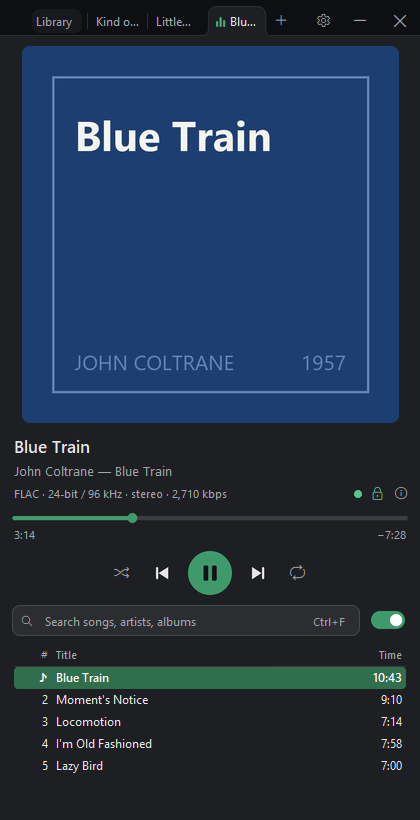
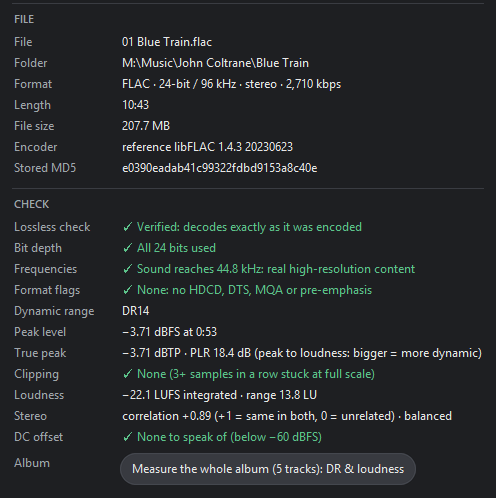
Let’s be clear about what it is not. Ironbark is not an AI clone of anything. It started from a blank folder on 2 October 2026 because John wanted a side player that proved what it played, and we couldn’t find a product that did. It copies no one’s code and no one’s design. That’s the whole point of the example: the same tools that can clone Office can just as easily build something that didn’t exist before, and the second use is the one with no legal cloud over it.
Here’s what building it with AI actually looked like, with numbers we can stand behind:
| Ironbark, as at 22 October 2026 | Detail |
|---|---|
| Started | 2 October 2026, from nothing |
| First numbered version | 0.1, on 2 October 2026 (first public build 0.28.2, 5 October) |
| Public on GitHub | 14 October 2026 (repository created 5 October), marked experimental |
| Current version | 0.51.5 (20 October 2026), after 25 tagged versions; 0.52 in testing |
| Code | About 57,000 lines of Python in the player, roughly 94,000 with its tests |
| Automated tests | More than 1,700, run on every change |
| Platforms | Windows 10 and 11, macOS on Apple silicon, 64-bit Linux, plus a browser version |
| Internet use | None. No update check, no look-ups, no tracking |
| Licence | MIT: free to use, change and share, including commercially |
| People | One, directing AI coding tools (Claude Code), with a second AI session acting as reviewer |
Three weeks, one person, and a product that two years ago would have needed a team and a budget we didn’t have. That’s Professor Kowalkiewicz’s hundred developers, except they built something new instead of a copy.
Now the part the forum posters leave out. The AI didn’t decide anything. It didn’t decide that a side player should be locked to a narrow shape, or that “bit-perfect” should be measured rather than claimed, or that the app should never touch the internet, or that the licence should be MIT rather than GPL, which meant keeping every GPL-licensed library out of it. Those are the decisions that make it a product rather than a pile of features, and every one was a person’s call. The AI also didn’t listen to it. Whether a USB DAC was really getting 24-bit audio, whether the clipping guard was audible, whether the meters matched the test signals: a human sat with headphones and found out, and the AI fixed what the human found.
It also cost real attention. Three weeks of it, with a change log, an architecture review, a code review, a bug hunt, and a QA gate before anything went public. We rewrote the project’s history once to scrub internal notes before making the repository public, and we still list it as experimental because it is. If you want forever software, you have to be prepared to run a small software project, even if nobody on it types the code.


What this means for a small business
You almost certainly don’t need a music player. But every business we visit has a list of small jobs that software should be doing and isn’t: the spreadsheet that gets rebuilt by hand every Monday, the folder of PDFs that needs renaming, the report that takes an hour to assemble from three systems, the reminder that someone forgets to send. Two years ago each of those was a quote from a developer, and the quote was usually more than the problem was worth. Now most of them are an afternoon’s work.
The rules we’d suggest, having just done it:
- Build your own tools rather than cloning products. If what you want is “Xero but free”, you’ve bought yourself a maintenance problem and probably a legal one. If what you want is “a thing that turns our job sheets into invoices”, build that.
- Keep it small. One job, one program. Six small tools are easier to keep alive than one big one.
- Own the code and keep it somewhere safe. A git repository, backed up. The code is the asset; the AI session that wrote it is gone the moment you close it.
- Keep your data on your own machine unless there’s a reason not to. Ironbark never uses the internet, and most small-business tools don’t need to either.
- Test it the way you’d test a new employee. Give it the awkward cases. Ask the AI to write automated tests, then read what they check.
- Release it if there’s no reason not to. An open licence costs you nothing, lets a customer or a competitor fix a bug for you, and means the tool outlives your interest in it.
- Keep a person in charge. Of what gets built, what gets shipped, and what the tool is allowed to touch. The AI is the workshop, not the owner.
That last rule is how we work. Every free tool on this site, every page, and Ironbark itself went through the same gate: a specialist drafts, a reviewer checks, and a person says go. The AI makes the building cheap. It doesn’t make the judgment cheap, and the judgment is what you’re paying a business like ours for.
The honest worries
The fear the ABC reports, of a flood of low-quality “slop” software, is well founded, and so is Dr Snoswell’s prediction of cost-cutting and worse software; the cloning tools will produce a lot of both. Our answer isn’t that it won’t happen; it’s that slop is what you get when nobody owns the result. A tool you depend on, that you can read and test and fix, is the opposite of slop whoever typed it.
The subtler worry, which the ABC raises and which we think is the real one, is who ends up with the power. The tool that frees you from rented software is itself rented. The AI coding assistants we use are subscriptions from a handful of very large companies, and if the only way to maintain your software is through them, you’ve swapped one landlord for another. Two things soften that. The code they produce is yours and runs without them, which was never true of the software they’re replacing. And open models that run on your own computer are improving quickly; in our experience they’re not yet good enough to have built Ironbark, but we’d expect one to manage a bug fix in it. The direction is the right one.
The ABC headline says the end of software. We’d put it differently. It’s the end of software as something you rent, from someone who can change the terms, for a job you could now do yourself. Software that you own, understand and can keep: that’s just getting started.
Common questions
What is forever software?
Is it legal to use AI to clone software in Australia?
Is Ironbark an AI clone of another music player?
Can a small business really build its own software with AI?
Does forever software mean it never changes?
Isn’t the AI itself rented software?
Sources
All checked 22/10/2026.
- James Purtill, An AI-cloned free tool is being dubbed ‘the end of software’, ABC News (ABC Science), 22 October 2026. All quotations from Brandon Thomas, Professor Marek Kowalkiewicz, Malcolm Burrows and Dr Aaron Snoswell are as reported there.
- Ironbark on GitHub: the code, the change log, the licence and the releases. The line counts (the
ironbark/andtests/folders on the main branch), tags, releases and test count are from the repository on 22/10/2026; the start and first-version dates are from the project’s own change log. - Ironbark: what it does, in plain English, with screenshots.
- Copyright Act 1968 (Cth): s 10 (a “computer program” is a literary work), ss 14 and 36 (reproducing a “substantial part”), s 33 (70 years after the year the author died), s 47D (reproducing a program to make an interoperable product) and s 47H (a licence term can’t exclude it). Current compilation on legislation.gov.au.
- Human authorship: Telstra v Phone Directories [2010] FCAFC 149 (an author is a human author) and Acohs v Ucorp [2012] FCAFC 16 (code generated by a program had no human author). The Government’s July 2026 AI announcement covers training, not who owns AI-written output.