

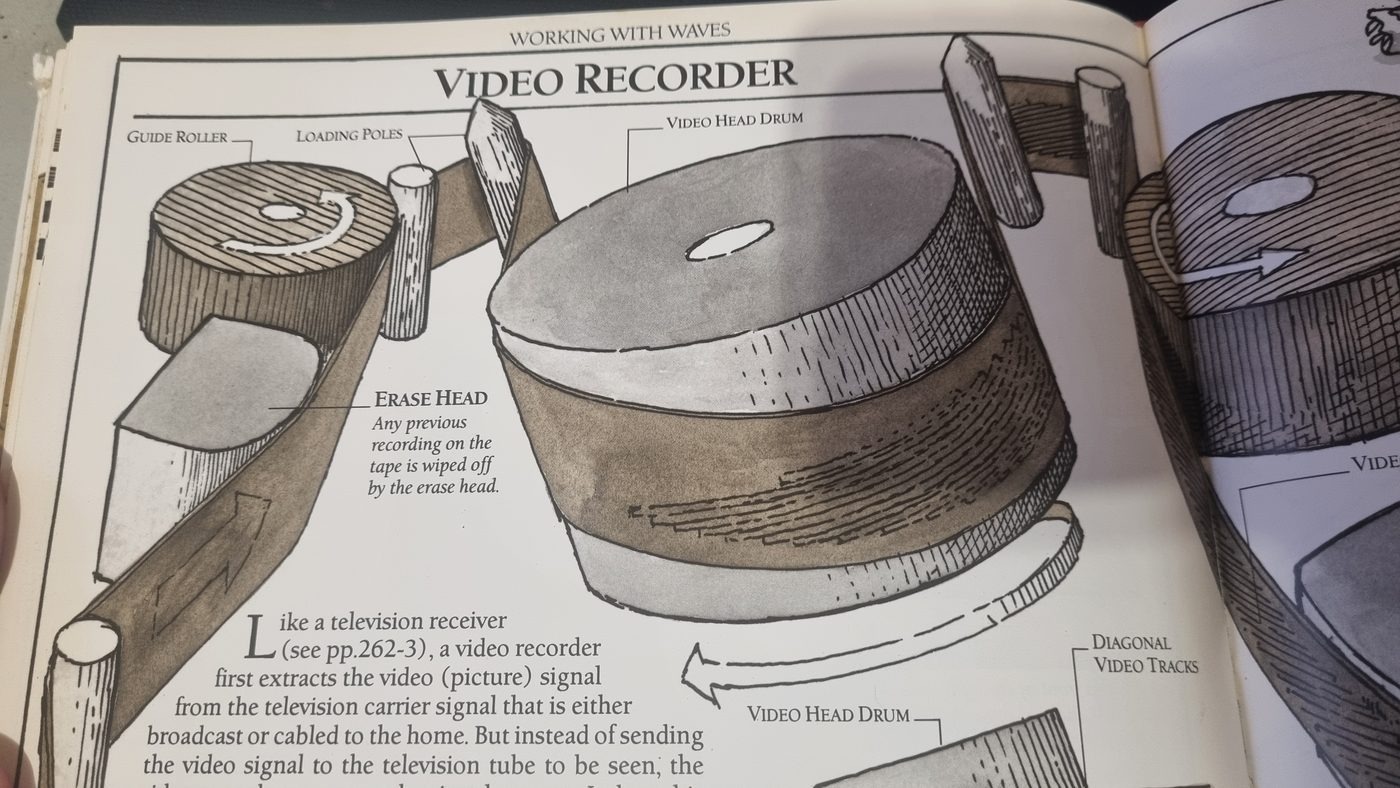
That spread is page 260 in the 1988 first edition, and page 244 of The New Way Things Work (1998), where the same drawing is reprinted unchanged. If you got here by searching for something like the way things work video recorder correction, or way things work head drum wrong direction — this is the page you were after.
There is no published errata sheet for the book, and as far as we can find, nobody has written this one down before — so here it is.
The short answer
In a VHS machine:
- The head drum rotates counter-clockwise viewed from above.
- The tape travels left to right viewed from the front.
- The tape wraps the face of the drum nearest the cassette.
Put those together and you get the thing that trips people up: where the head touches the tape, the drum and the tape are moving the same way. The drum runs with the tape, not against it.
Both seen from above — tape runs left to right
Why that feels wrong
The natural intuition is that you would spin the drum against the tape, so the two speeds add up and you get a faster recording for free. It is a reasonable thought, and it is not how it works — because the tape contributes well under one per cent of the head-to-tape speed. The head is crossing the tape at nearly 21 km/h; the tape is ambling along at about 3 cm per second. Nobody was ever going to design a format around that difference.
So the direction was never really a choice. It falls out of the mechanics — where the reels sit, which face of the drum the tape is pulled around — and once the format existed it was frozen into the standard, because a tape recorded in Osaka has to play in Adelaide.
Check any diagram in three steps
- Find the tape’s direction. Look for the supply and take-up reels, or find the erase head — the tape always passes it before the drum, because the old recording has to be wiped before the new one is written.
- Work out which face of the drum the tape wraps. It is the side facing the cassette, towards the front of the machine — nearest you in most drawings.
- Compare the arrows at that face. They should point the same way. If the rotation arrow opposes the tape, the diagram has it backwards.
About the book
None of this is a knock on The Way Things Work. It has been my go-to reference for about thirty years — whenever I want to know how something actually works, rather than a summary of it, that is the book I reach for, and I still take it off the shelf regularly. Macaulay draws a machine the way a good teacher explains one: he shows you the part that matters, at the angle where you can see why it matters. Several hundred spreads of that, done with extraordinary care.
This is one arrow on one page. It is also genuinely hard to spot — invisible unless you deliberately trace the tape and hold it against the rotation arrow, which is a strange thing to do unless something has already made you suspicious. The people who would catch it instantly are VCR service technicians, and they were not who the book was written for.
For the record: the spread is page 260 in the 1988 first edition, reprinted unchanged as page 244 of The New Way Things Work in 1998. The 2016 revision, The Way Things Work Now, dropped the video recorder entirely — the format had gone — so the arrow was never corrected so much as retired along with the technology it described. We still recommend the book without hesitation.
Common questions
Is the video recorder diagram in The Way Things Work wrong?
Which way does a VHS head drum rotate?
Why not spin the drum against the tape for more speed?
Why is there a spinning drum at all?
If you got here because you were staring at that page thinking you must be missing something — you weren’t. Trust the trace.